Monday, May 22, 2006

Getting around in Cusco

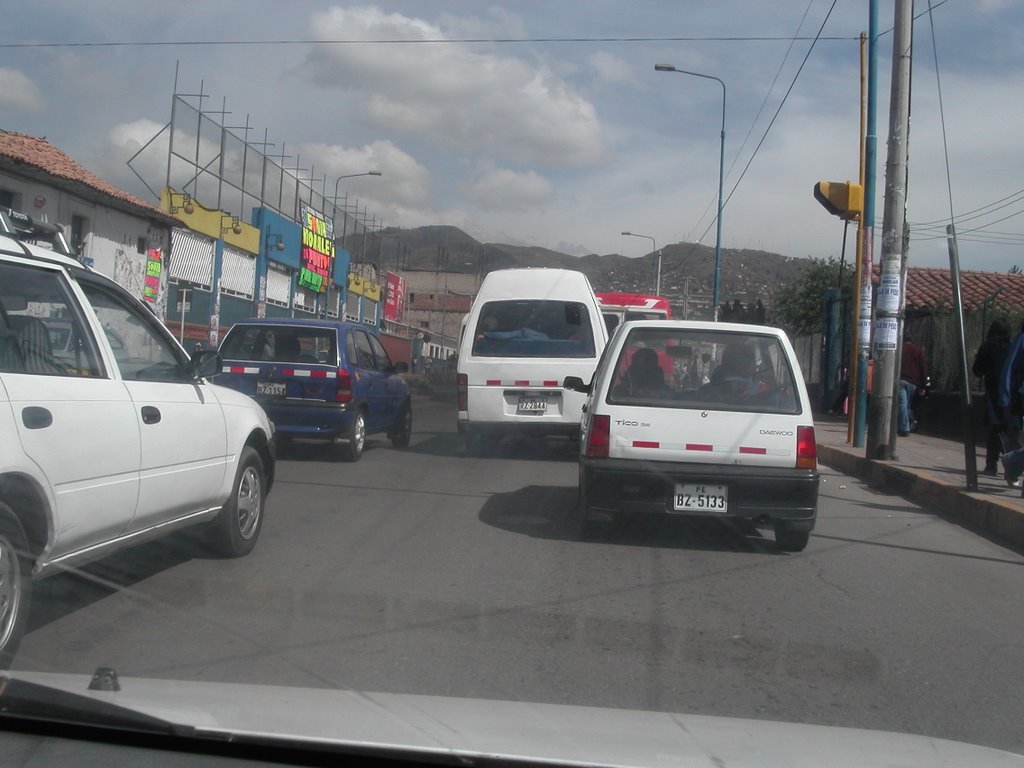
Getting around in Cusco can be an adventure in itself. Given the general pleasant surroundings and amiable climate, walking is the preferred mode of locomotion but for slightly longer trips or when transporting loads or children or loads of children, taxis are preferred. Generally, a taxi will take you anywhere near the city center for two Sols (about $.60) during the day or three Sols (about $.90) at night. The taxis are almost all of two varieties. The most common are the Daewoo Tico which is not much larger or more powerful than an enclosed go-cart. The alternative is the Toyota Corolla wagon, which has the advantage of the cargo area in the rear for either goods or people. I’ve personally ridden in these taxis with over seven adults and more than a few kids. Both cars are hand-me-downs from abroad. The former were shipped to Cusco upon expiration of their useful life as taxis in Korea and the latter arrived after they exceeded their legal life as taxis in Japan. While some might be concerned about the condition of taxis which others have been decreed as too old and decrepit for safe public transportation, such fears are soon eclipsed by the driving habits of the Cusco drivers. Traffic rules in Cusco are much more fluid than those in the States. Signals are rare and stop signs treated as mere suggestions. Once traffic is flowing in one direction, it continues until stopped by another stream of traffic. Such a system is actually a bit more efficient as much less time is spent stopped at intersections. Drivers squeeze in wherever they can fit and traffic lanes are created on an as-needed basis. Right turns are often made from the far left lane across many rows of cars and, for some reason which I was never quite able to determine, left turns often have the right-of-way. In order to get the attention of drivers and encourage them to follow transportation ordinances, city workers would occasionally dress as clowns and station themselves at busy intersections sporting signs that read, “don’t honk your horn,” “use your seatbelt,” and “obey traffic laws.”

In lieu of a school bus, I arranged for the kids to be brought to and from school every day in a taxi with other children from the same area. Such a taxi is known as a mobilidad. The car was basically full of kids by the time it got to our house and then I would just shove in Zak and Maya, usually one on top of the other, and off they would go. Our mobilidad was a white Toyota taxi driven by Sr. Braulio who, although his own kids were among the passengers, I learned was one of the faster, scarier, and more-aggressive drivers with which I had the pleasure of riding. Although recent law required seat belts for drivers, they were not commonly used or even available for passengers. Subsequently, I forbade the kids from sitting in the front seat and made sure they were firmly ensconced in the back seat when I sent them off to school. I rode with the taxi on Zak’s last day of school and noted that the children seemed to be particularly attentive to the other traffic. This piqued my curiosity. When a police car was spied by the kids, a general alarm was sounded and all those sitting in the rear cargo compartment dropped to their sides, lowering their heads below window level. I figured that riding in the back was illegal and this was confirmed when we passed another mobilidad who had been pulled over by la policia who was writing the driver a ticket while a hordette of school kids stood and watched. While the taxis are interesting, it’s the driving that’s really exciting

Braulio was by no means the exception. At one point during her visit Mary noted that, just when you are convinced that no driver could possible be more aggressive, you take another ride and are proven wrong. One form of amusement for me was to put new visitors in the front seat and watch their reaction to the ride. I only got to try this once with my father, thereafter both he and my Mom refused to sit up front. I also had to keep reminding guests that pedestrians do NOT have the right of way in Peru. When crossing the street we get used to the idea that cars will stop but that is not the case in Cusco. I’ve actually ridden in taxis and had the sensation of the car speeding up when a pedestrian was crossing in the street ahead. The drivers seemed to have a bit of a fatalistic streak that was of scant comfort. All of the drivers would cross themselves when driving in front of a church and almost all of the taxis displayed a variety of religious icons, the most popular of which was Señor de Huaca, which depicted Jesus being flayed by Roman soldiers with a cat of nine tails. There were many times when I wished they were paying more attention to their driving in the here and now rather than cultivating their familiarity with suffering and the afterlife.


Tuesday, May 16, 2006

Chinchero Hike


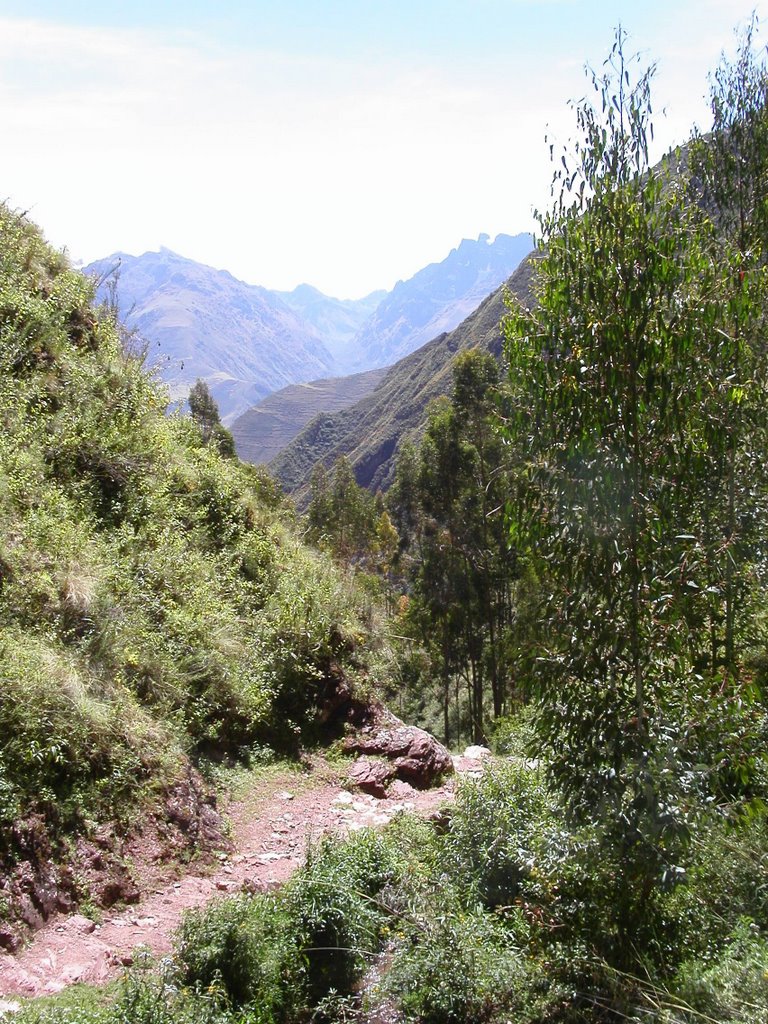
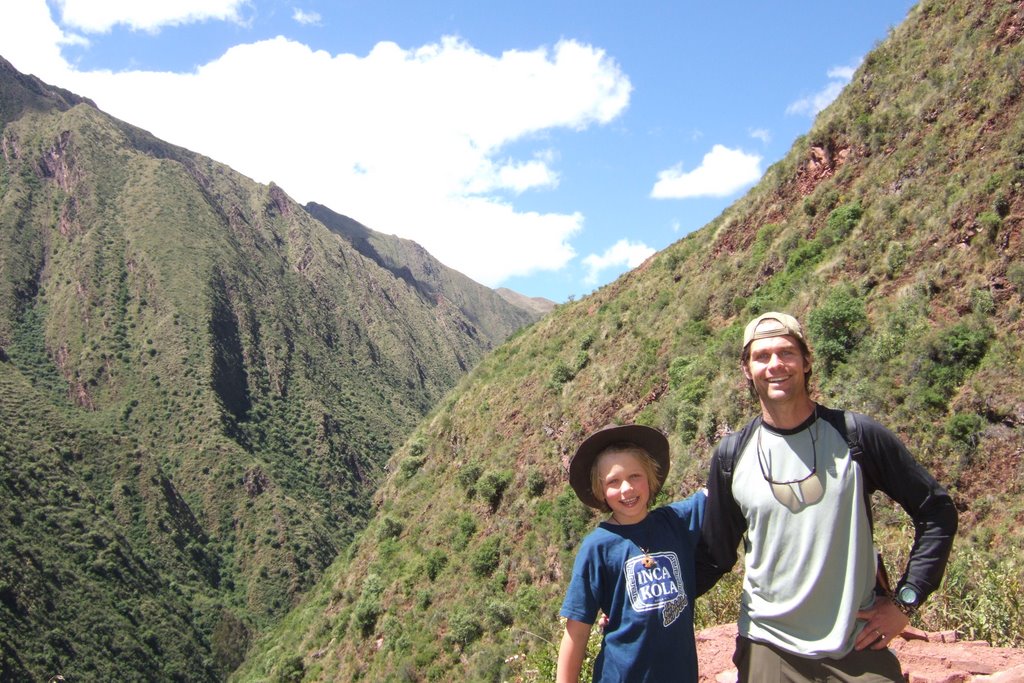
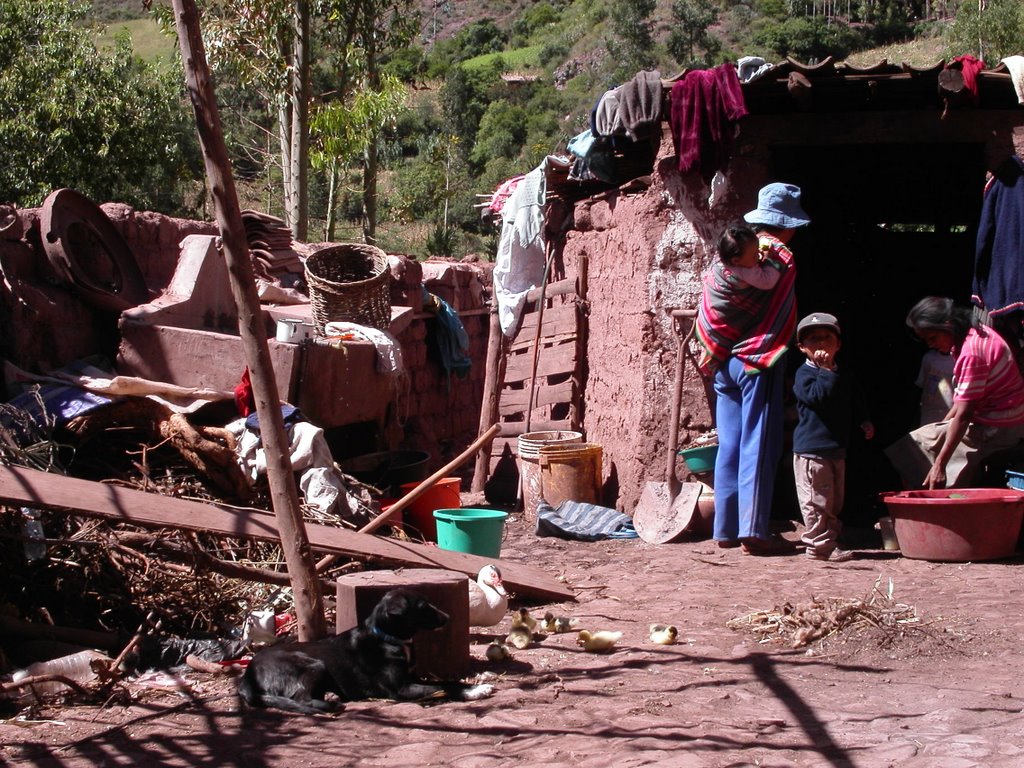
On Tuesday, I cut Zak loose from school so that he and Bart and I could try a hike I heard about from the town of Chinchero down through Urquillos toward the valley floor at Willcaibamba. I had heard the route was an exciting downhill bike ride but even I hadn’t bargained for the incredible scenery. Once we completed the majority of the downhill, we encountered the village of Urquillos where we found a chicharia in a local house. The proprietress spread a blanket on a plank on which we parked our butts while Bart and I enjoyed a chicha and Zak played with some baby geese. The kids were obviously intrigued by us gringos but too scared to come out from around the corner and talk to us. In Willcaibamba we passed both a witch doctor’s office and a giant statue of a farmer with a corn; I’m not sure which I found to be more disconcerting. While the Valley is decidedly untouristy, giant statues are quite popular; Calca features a statue of a giant woman (with giant blemishes?) in native dress while Urubumba has a decidedly unintimidating statue of a giant puma. From Willcaibamba we caught a VERY crowded bus to Calca (I may have accidentally squished a young girl en route) where we lunched in Calca before relaxing at the Machacancha hot spring North of town before heading home. Zak has really become quite the hiker although he says prefers riding horses; although any day off of school is a good day off of school.

Los Farroles Del Duke


Thursday, May 11, 2006

Cusco Climbing


One day, as I was walking from Salumpunko to Ikiltambo, I was looking at all of the beautiful scenery and thinking about the untapped potential for establishing climbing routes in the area. I’ve got to get back here with my buddy Mark Williams. He and a friend were responsible for developing Red River Gorge in Kentucky and he has a lot more experience putting up new routes than I do. As I was mulling over these prospects, I looked to my left, at the backside of a large limestone outcrop whose facade was, in part, responsible for my current line of thought when I saw a line of new bolts leading up to the top. So, there were climbers in the area! That very afternoon, after a long and satisfying walk to a number of both Incan and natural wonders, I stopped at my local laundry, run by mother Marisol and daughters Jengele and Chaska, when I found a flier for Le Sommet, a bar/restaurant with an indoor climbing wall. If there is a place to meet the local climbing crowd, this must be it. The restaurant turned out to be closed until Sunday, April 30 but, sure enough, on my first visit I met the owner, a French woman named Danzella and Luis Quispe, a young Peruvian who had extra gear and agreed to take us out to some local routes. And, a week or so later, on Bart’s last full day in town, Bart and Zak and myself found ourselves hiking with Luis and a friend of his, a Canadian girl named Josie who was in Cusco escaping the cold of Baffin Island.

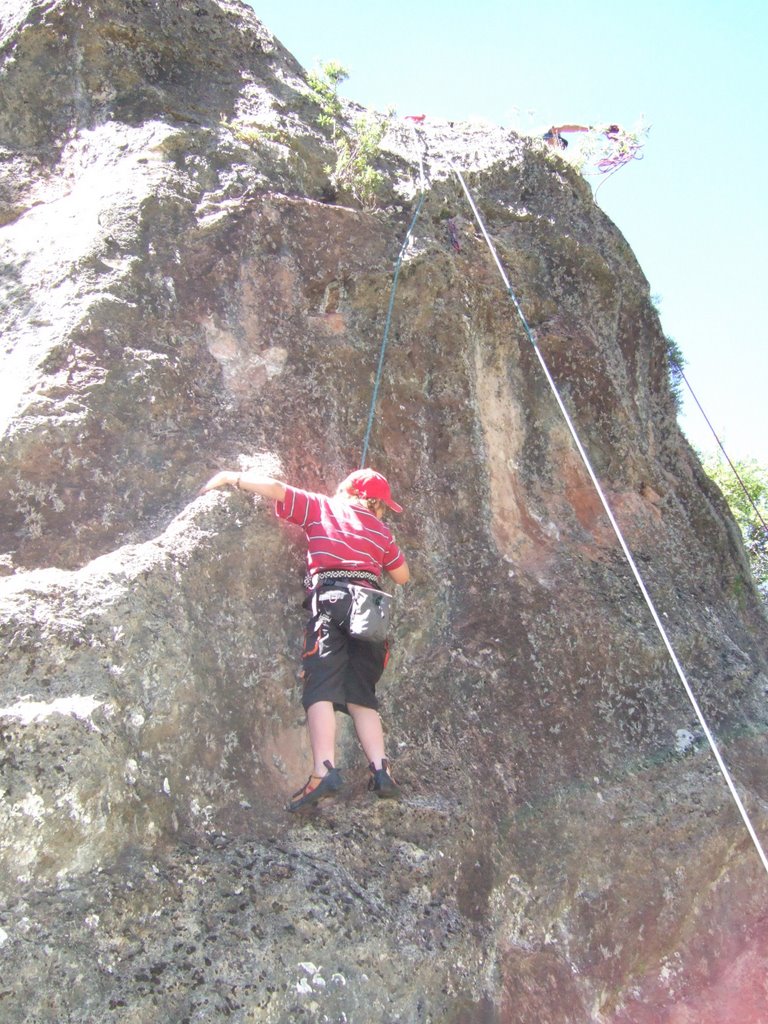
To my surprise, Luis led us directly to a rock immediately below the Inca Ruins of K’usillochayuj that Mary Walsh and Mary and I had hiked to some weeks prior. We were climbing directly above Inca terraces and potato fields that have been in use since they were first constructed by the Incas some 500 + years prior. Luis’ gear looked brand new. This could be good because it looked reliable but, since it obviously hadn’t been used much, it could be bad since it raised concerns about the reliability of the guide. While Luis set a top rope, I talked with Josie and learned that it was she who had purchased the gear in Canada on Luis’ behalf and brought it down to for use with his nascent guide service. So far so good; he had climbed a lot and was just now going into business, all questions answered. I volunteered to go first and was surprised to find the rock gritty and covered with lichen. Luis was putting in some gear on rappel on a route around the corner to the right and I was surprised to hear him hammering in pitons and clearing out some sizable bushes. I was later to learn that, while Luis had scoped out the rock before, this was his first trip to the spot with clients. Subsequently, I ended up completing three first ascents along the face of the rock although Luis deserves equal credit, of course. From left to right, they are: The Pisco Kid (El Nino Pisco) a 5.6 that ascends the left arrete; Joses a 5.8 that goes right up the center passing through left side of big red dish; and El Campesino Molesto, a 5.7 which goes up the right arête and then through the same red dish. The best route, however, was around the corner to the right directly above the creek. The direct start is as yet uncompleted but the start from the lower terrace (below the field and above the creek) is a stimulating 5.8 I call 1% Peruano that was an even more exciting 5.9 when I was cleaning the bushes out of a beautiful hand crack above the last piece of gear.

All in all, it was a great day climbing except for the intrusion of a grumpy old man (the campesino molesto) who farmed the fields below and for some reason was extremely offended that we were having fun and minding our own business on the rock abutting his field. This compelled him to vent his impotent frustration before we were allowed to finish our day. Who's got the time for all of this negativity? We did our best to ignore him and while he sputtered on Josie told me that it was quite common for the locals to behave in such a manner; upon reflection, such behavior jibed with my experiences retrieving soccer balls kids had accidentally kicked into yards adjoining the soccer field near our house.

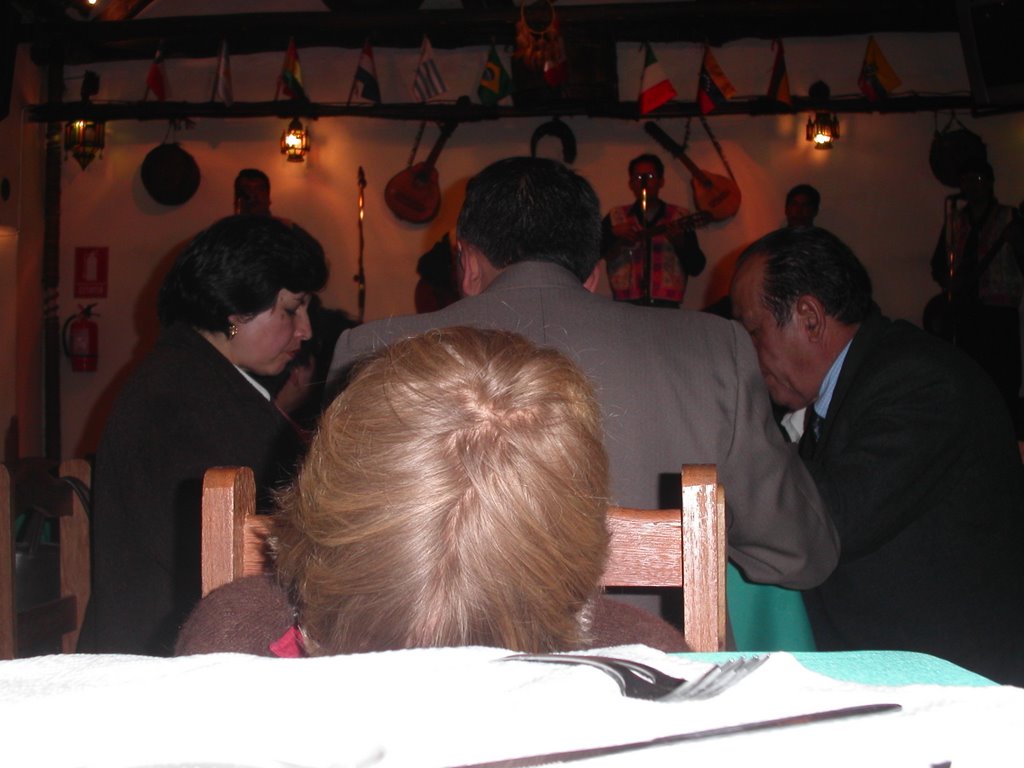
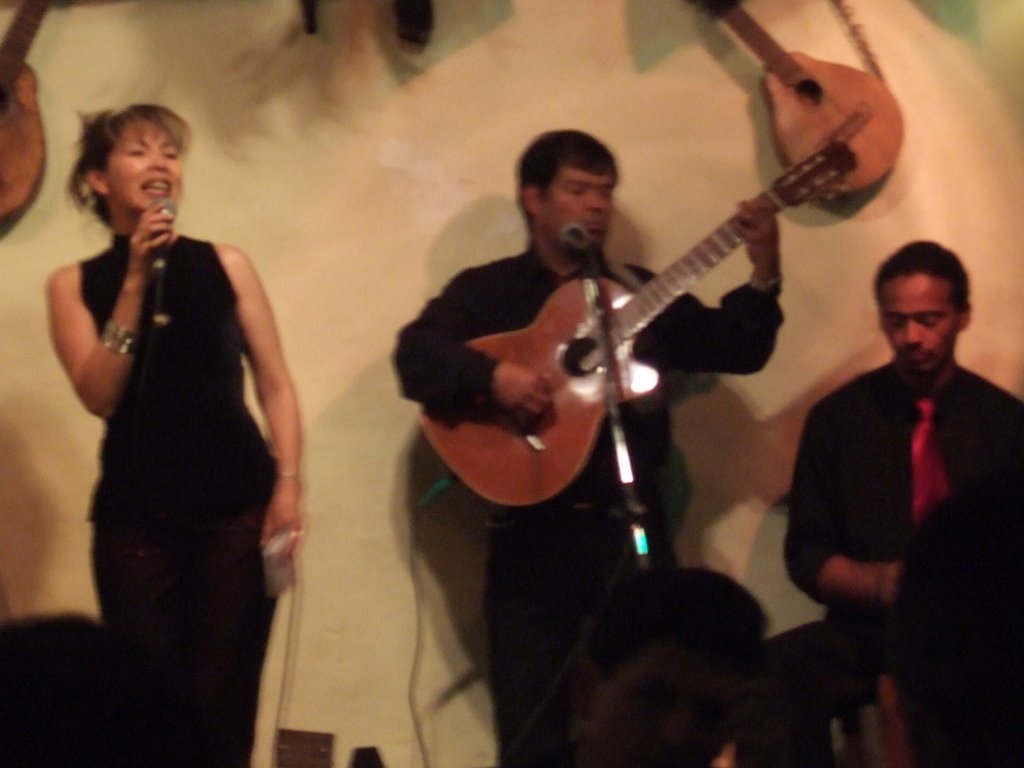
That night, we met our Peruvian friends Yanet and Doris and Doris' daughter Carolina for dinner to wish Bart a happy Bon Voyage. Bart's original choice, was the hip and trendy Los Perros but we were unable to find a table so we found our way over to Los Farroles Del Duke down the street. Zak was so tired, he fell asleep before the dinner arrived. He was briefly revived for the soup course before falling back asleep, luckily not with his face in the bowl, while the rest of us danced to first an Andean band and then the salsa of Nancy Flores and her band. An excellent way to end an excellent visit.

Tuesday, May 09, 2006

Huchuy Cusco


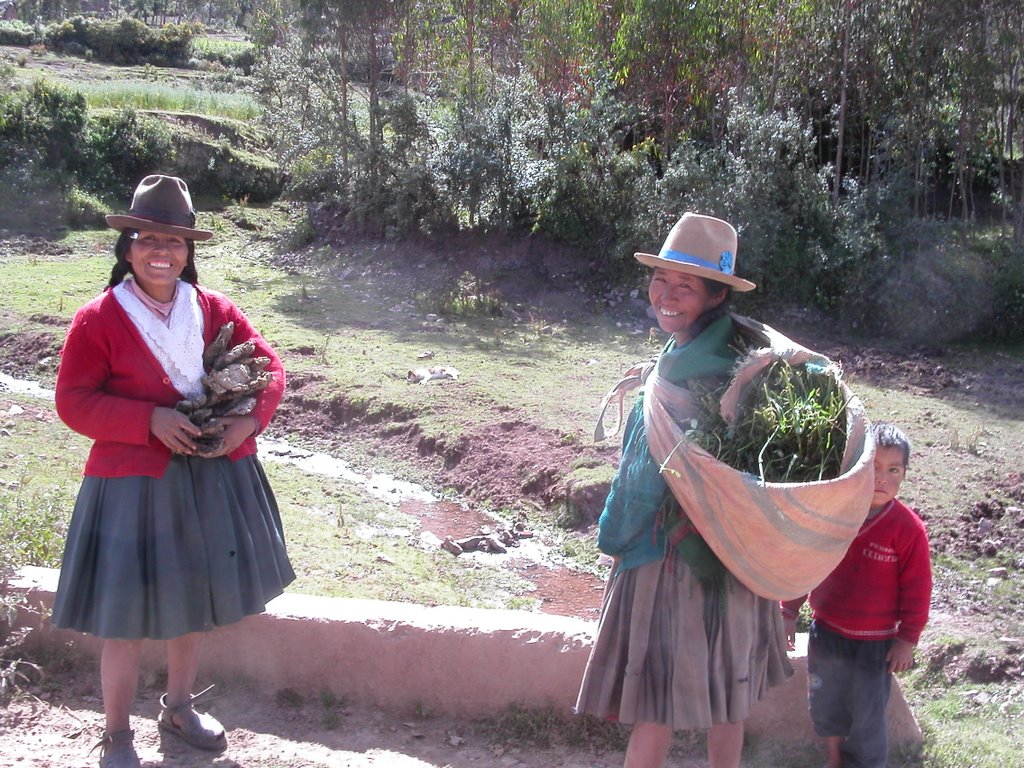
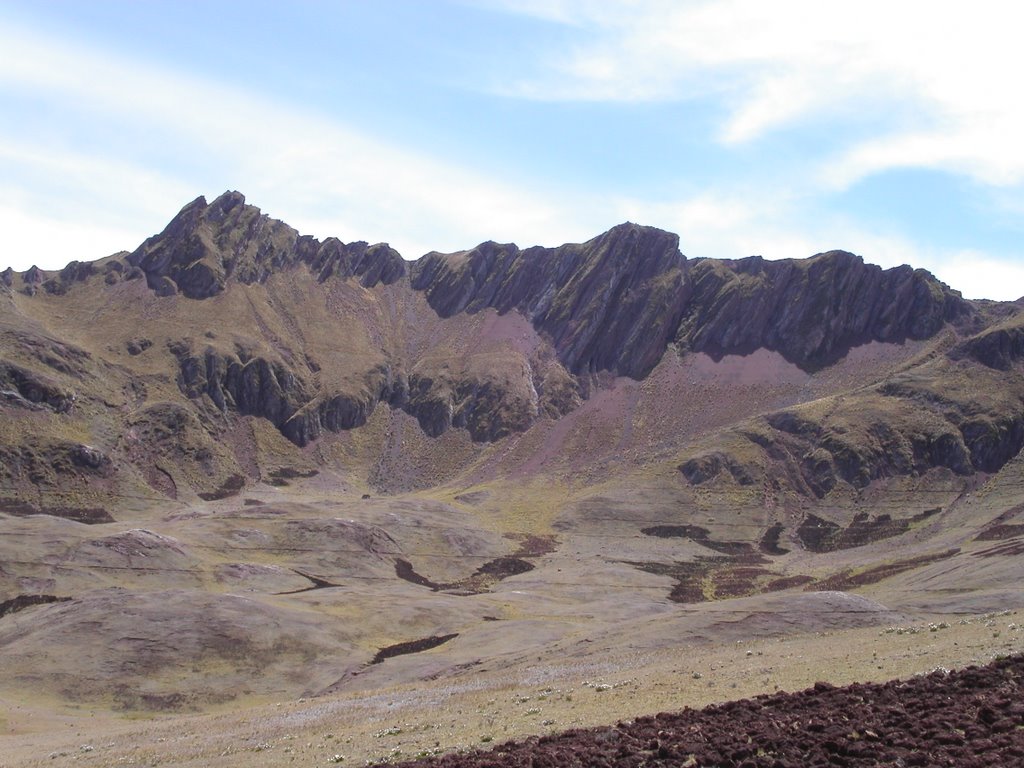
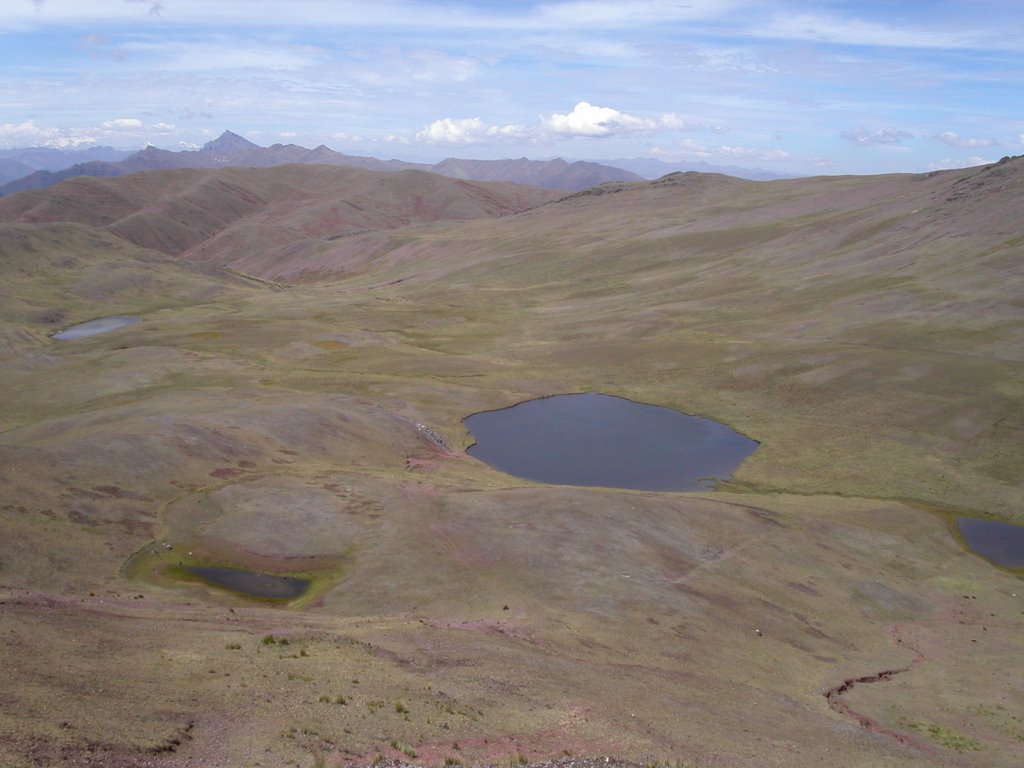
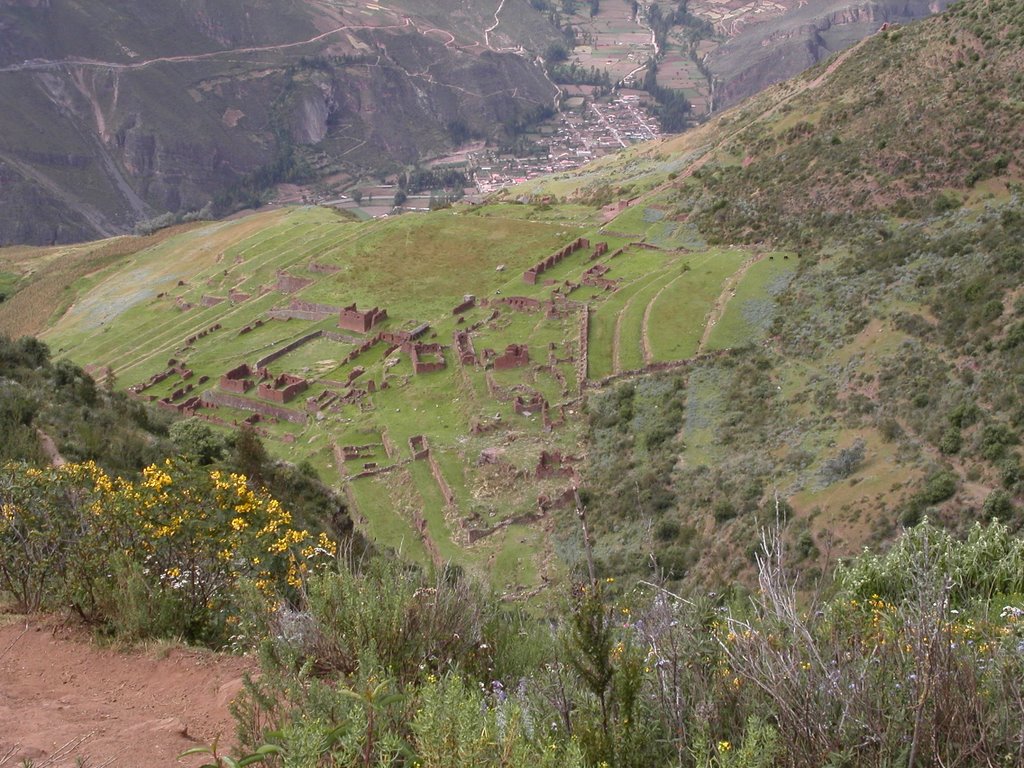
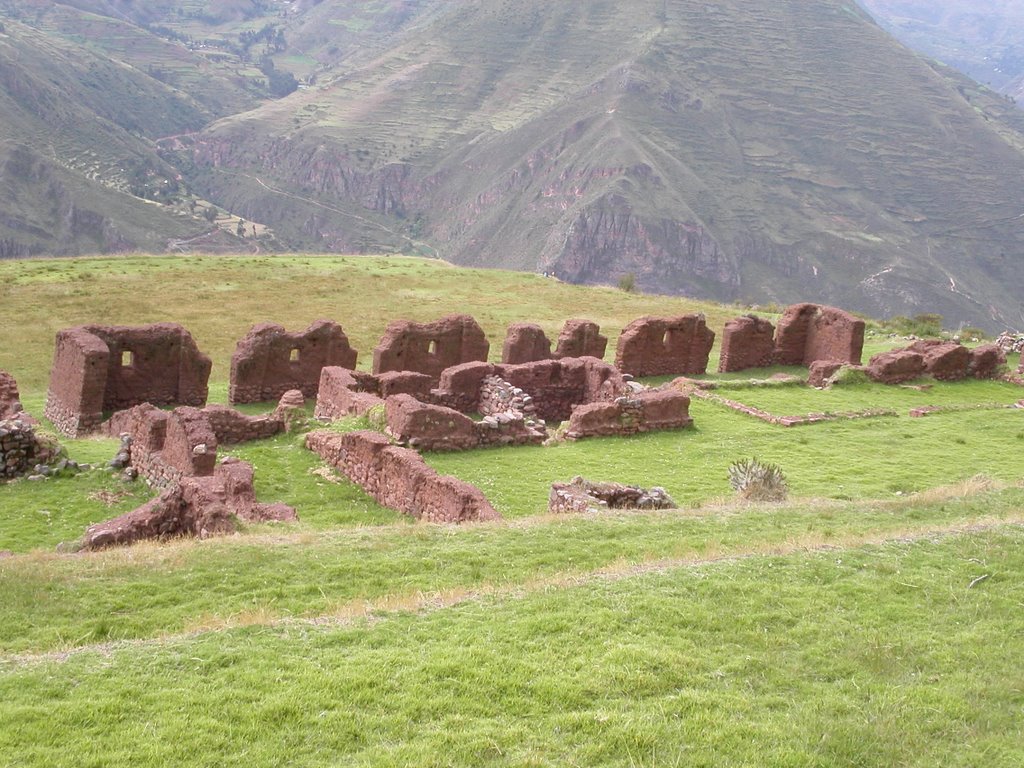
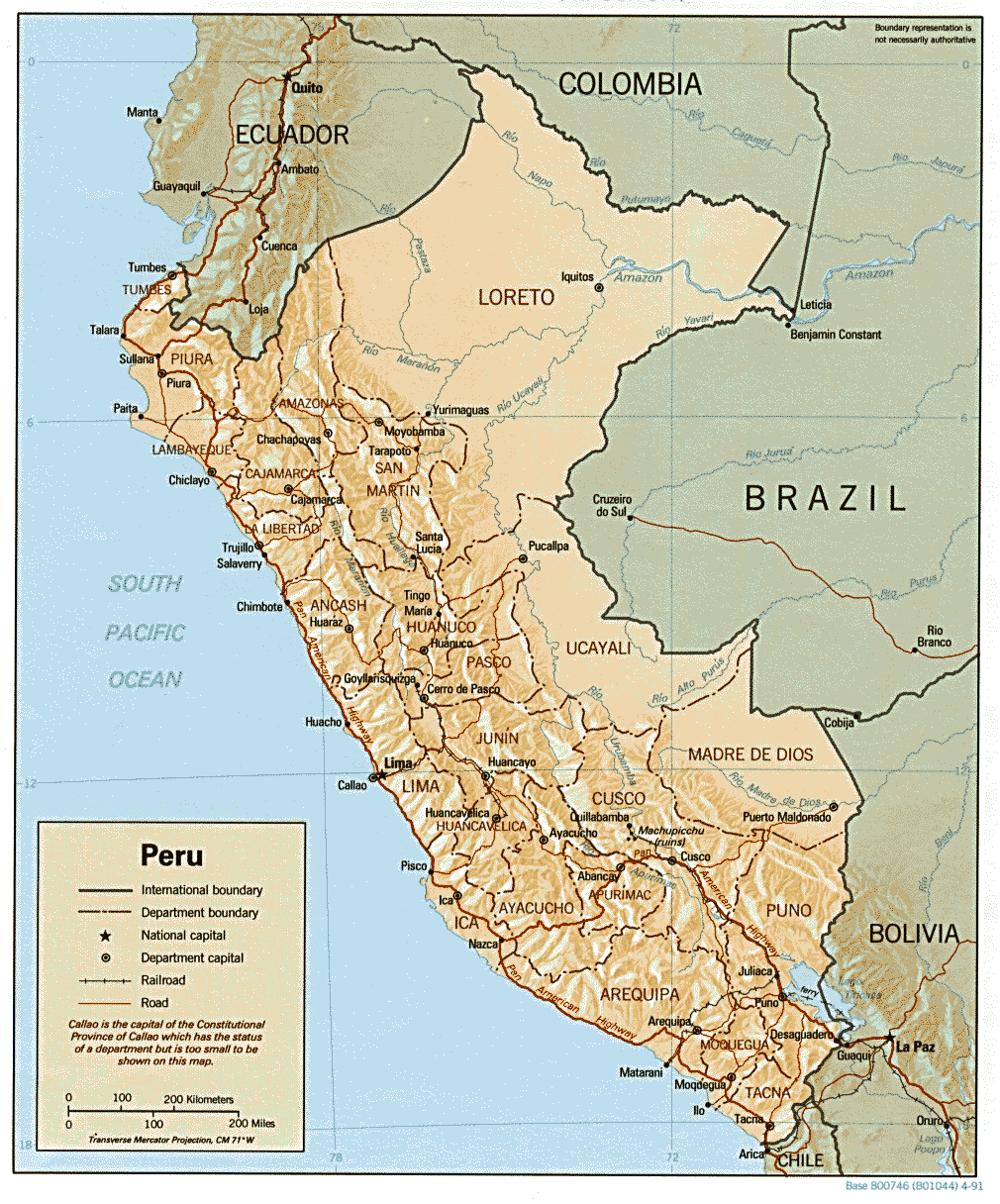
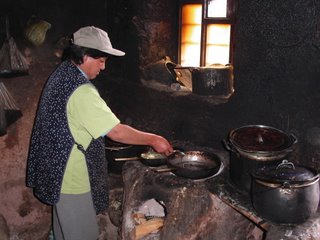
One of the places I have been hoping to visit before I leave Cusco are the ruins of Huchuy Cusco. These are not on a road but rather command an incredible and rather inaccessible vista about 1000´ above the floor of the Sacred Valley. The most direct route to the ruins is to hike directly up the switchback trail from the town Lamay in the Valley to the North and return on the same. Having always had something of a skepticism toward the direct approach – always forward, never straight – I planned a hike from the South that would take me cross-country to Huchuy Cusco and then out to Lamay. I chartered Jaime, of taxi fame, to bring me to the trailhead in the pueblo of Tauca, east of Chinchero. I then started looking for a good topographical map. No mean feat. The town is full of tourist maps that will guide you to the popular destination of your choice but other more obscure destinations remain shrouded in the mists of obscurity. I wanted to part those mists and I figured a little bit of route-finding would just add to the adventure. I wasn´t worried about getting lost as I knew I could just keep hiking to the North or West and get to a road. If I had to, I could collect dried llama dung for a fire, like the woman on the left in the second picture above, just below the silly looking guy who still thinks he can do 20-something adventures even though he is 40. I was set for the perfect hike… but then I decided to add a bicycle. I had been wanting to go mountain biking and I figured I would kill two birds with one stone but, like Sisyphus, the stone just about killed me. My route started at over 12,000´ and would take me to over 14,000´ but I was acclimatized to the elevation, so I figured I wouldn´t have too many problems. The hike was indeed spectacular and I didn´t suffer much by having to push a bicycle most of the way up. I ended up pushing it most of the way up because the route turned out to be much steeper than I anticipated and every time I would get on and pedal for a bit I would leave myself gasping for air. Almost the entire time I was well above tree line and treated to beautiful vistas of mountains and alpine lakes. I crossed two passes and then started downhill toward the ruins to the North. The basin I was following narrowed to a ravine which forced me stash the bike in some tall grass (there were no trees to lock it to) and continue downhill on foot. I had to share the path with a number of llamas who were in the creek bed of the ravine enjoying some cool water and green forage. They didn´t know quite what to make of me – I was the only human I´d seen all day and who knows when was the last time they saw a biped – and they were often a bit reluctant to make way. Eventually I crossed an Incan outpost guarding this approach to Huchuy Cusco, then some Incan terraces, and then a small plateu below which I was treated to a spectacular view of the ruins, way, way, below me. I´d come this far so I pushed on and I´m glad I did. The ruins were impressive, not because they were the most well preserved or constructed or largest, but because they were so remote and because I had them all to myself. As opposed to Pisac or Ollantaytambo or even Machu Picchu, Huchuy Cusco was primarily constructed of adobe over a stone base and has remained very well preserved. After enjoying the ruins, rather than heading downhill to Lamay, I was forced to retrace my steps back up, up, up to where I had left the bicycle then retrace my path over the two passes before I was able to put the bicycle to good use on the downhill all the way out. I can say, with a high degree of confidence, that I completed the first downhill descent on a bicycle from the pass above Tauca to the town itself and I don´t anticipate the route being repeated in the near future.

I originally had visions of perhaps riding all the way back to Cusco, but it was starting to get dark so I hired a beat-up old taxi that was riding on at least one “donut” spare. The spare was apparently losing air pretty consistently as we had to stop and refill it on the way back but that didn't deter my driver from trying to deliver his fare to Cusco at the highest possible speed; perhaps he was concerned about getting to the next air pump before the tire went completely flat? We made one other stop at a garage for what mush have been the original tire. As he carried it to the car, I noticed that there was a rather largish-looking blowout on the sidewall and the main "tread" was as smooth as my friend Will's pate. I jokingly asked what he was going to do with the old tire and he replied with a look that said, Duh, and told me very matter-of-factly that he was going to repair it and put it on the car. This got me thinking about the condition of the other tires which wasn't all bad, as far as trains of thought go, as it gave me something to think about other than the electrical system of the taxi which must not have been good as he would only turn on the headlights when we were approaching or overtaking another car. When we approached a vehicle checkpoint in the town of Poroy outside of Cusco, I also learned that he didn't have the proper license to legally transport paying passengers to Cusco so I joined him in a little celebratory cheer as we were waved through while he laughed at the driver of the big modern, tourist bus who was forced to pull over so the police could check his papers. To top the drive off, he refused to deliver me all the way to the central plaza, because of the risk of apprehension, so I got to end my journey with a little ride through the crowded but dark streets of the historic center of Cusco. I was beat, both mentally and physically, but it had been a great day.

Sunday, May 07, 2006

Lares


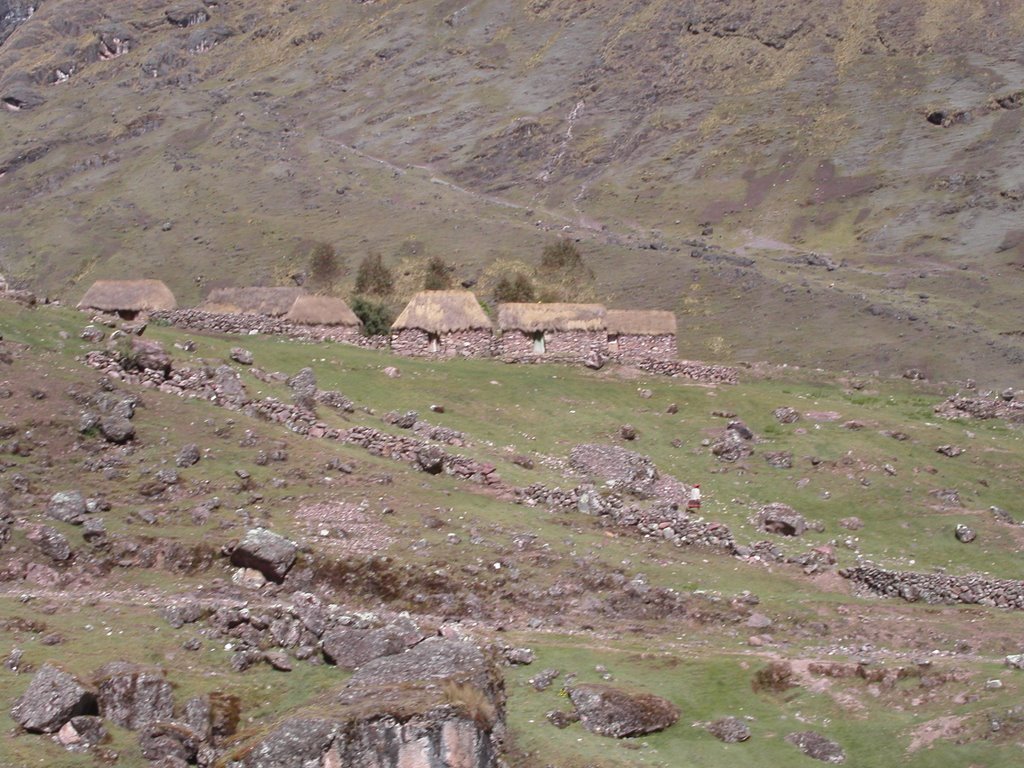
On Saturday, the kids and I went to Lares, a small town at the head of the valley by the same name a few hours North of Cusco. The original plan was to take a bus to Calca in the Sacred Valley and then the local bus to Lares on the same the next day. However, when I found we would have to leave our house before 5:00 a.m. I called Jaime, my friend the taxi driver, and arranged for him to bring us to the bus in Calca. However, when he arrived in the morning he told me he had never been to Lares and would like to go with us but he would have to return that night. I certainly didn´t want to deprive him of the opportunity so I agreed and off we went. Zak and I had originally hoped to take a four day hike to Lares with a friend but we basically ran out of time and Mom felt that four days was a bit too long to leave Maya with someone else in a foreign country. Lares makes a fine destination in no small part because of a series of hot springs just outside of town alongside a beautiful river. But, like many things in life, the best part is getting there. Both the road and the hiking path, cross a mountain pass at about 14,000 feet which allows for many miles of travel above the tree line to the accompaniment of scores of beautiful vistas. The locals primarily subsist by animal husbandry with llamas being the most popular stock at the higher elevations. Homes and corrals are constructed out of the same ubiquitous stones that make farming next to impossible. Current habitations are indistinguishable from the 500+ year old Inca houses save for the fact that those houses presently occupied are covered with thatch roofs. We had a great time in the hot springs although Zak and I burned our shoulders even though we liberally applied sun block; the sun at these elevations is brutal on us gringos. We ate dinner at a small local restaurant and Maya was so tired from playing in the springs that she fell asleep at the table so we returned a bit earlier than we had planned.

The Foods of Cusco


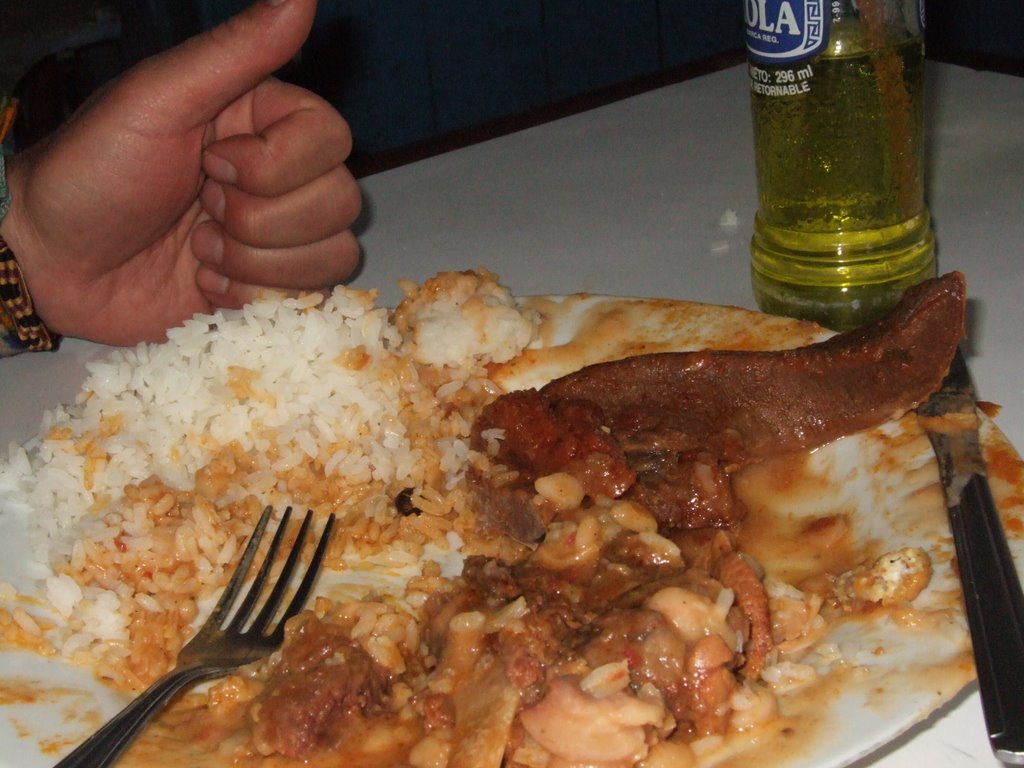
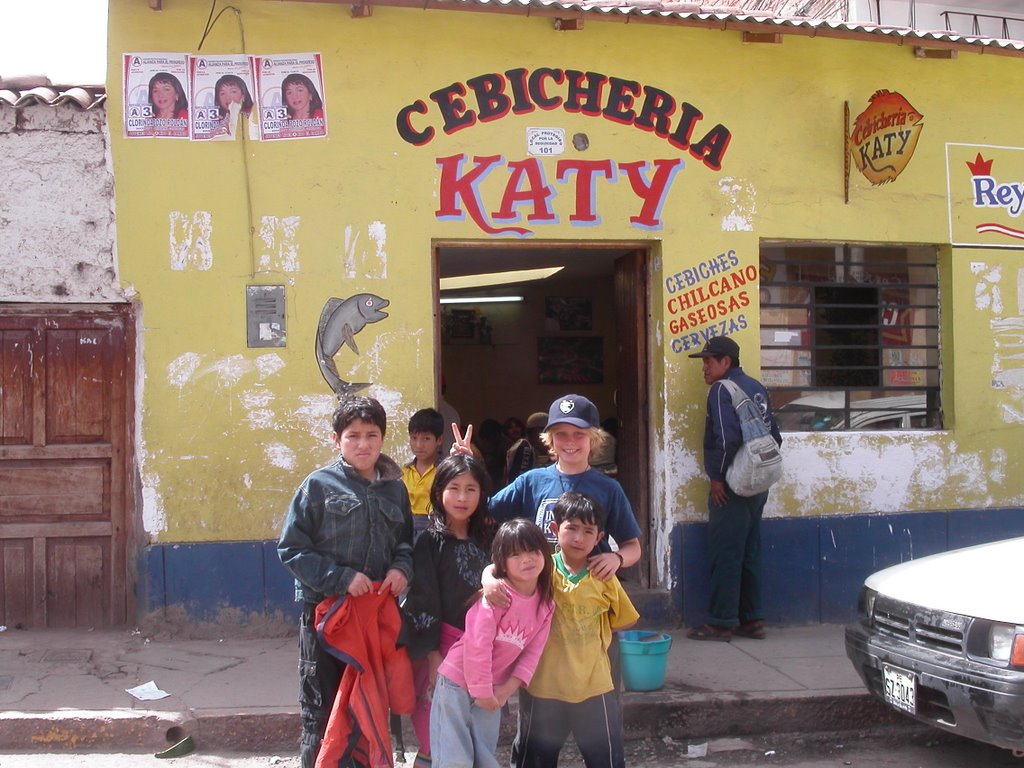
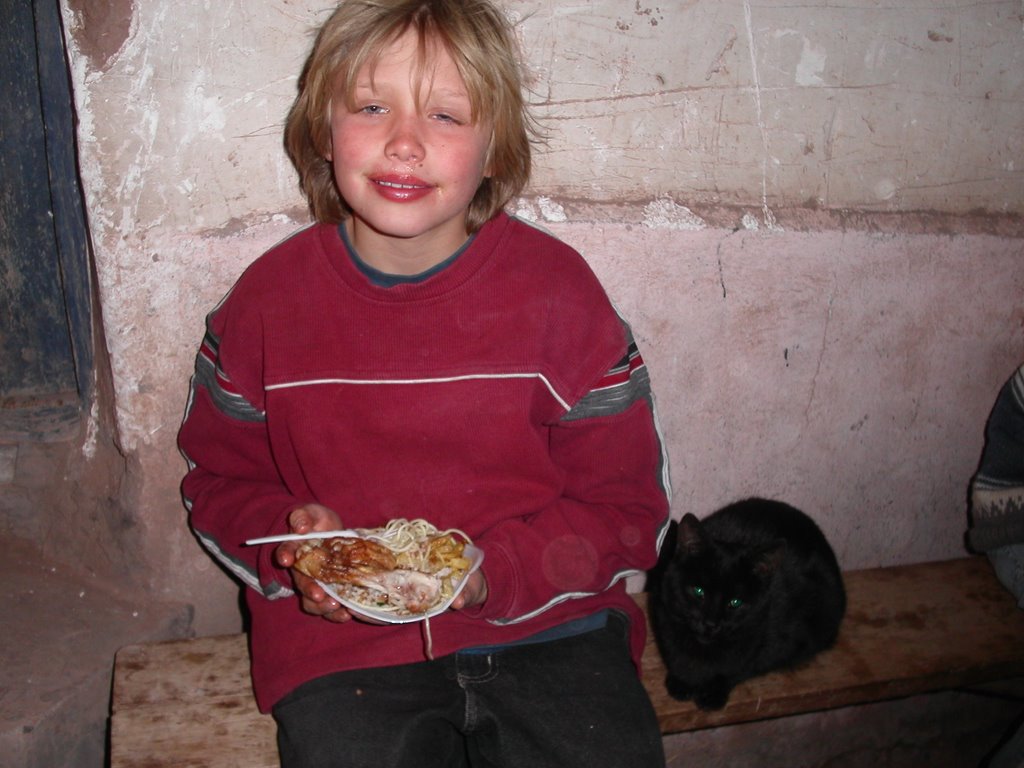
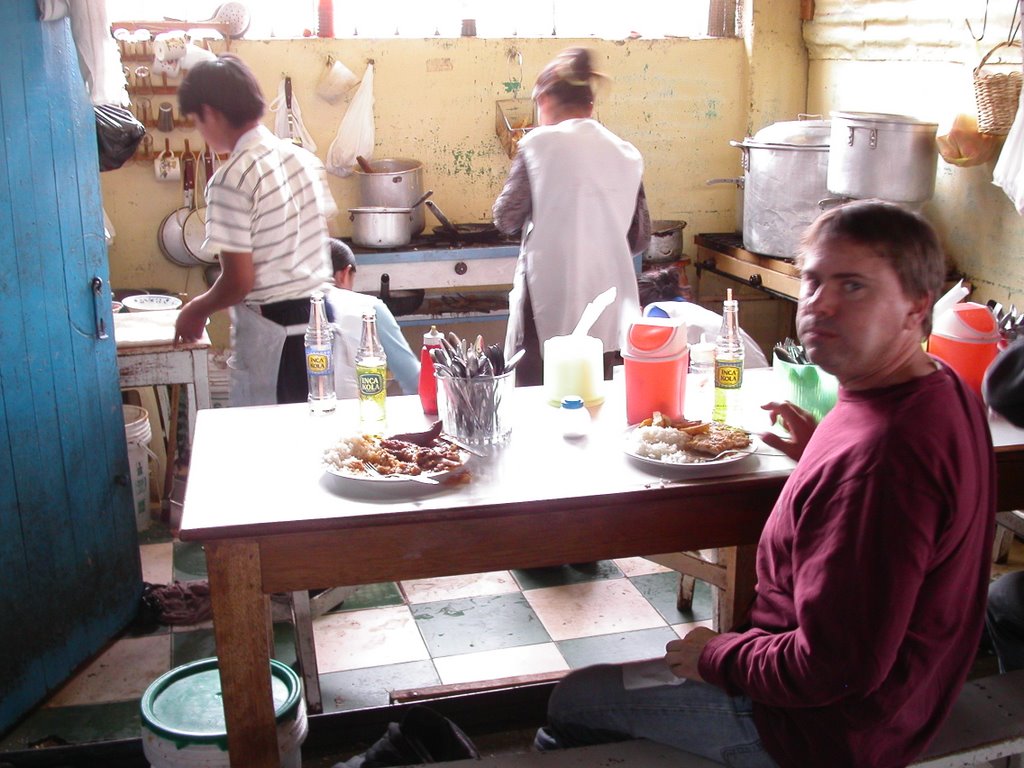
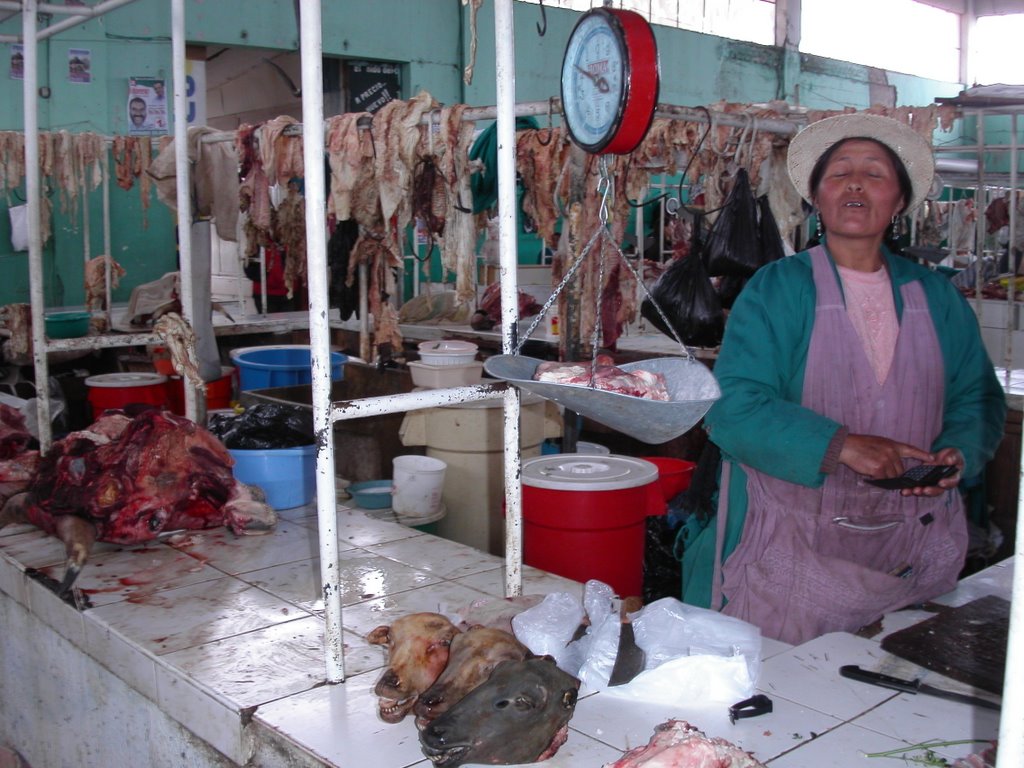
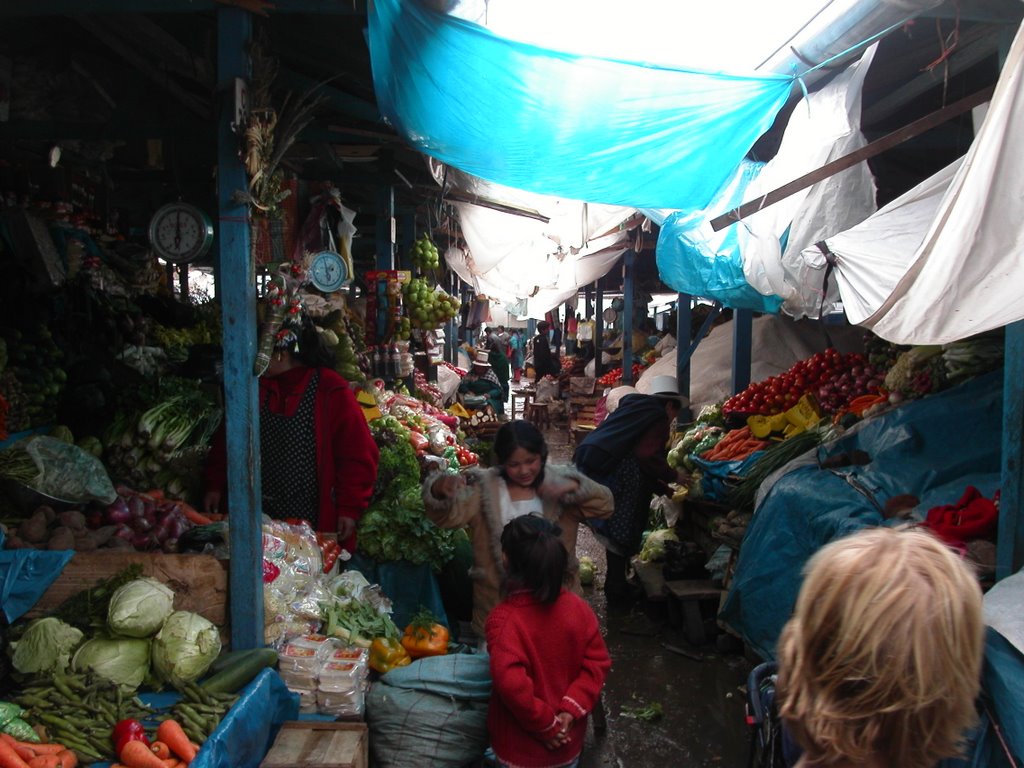
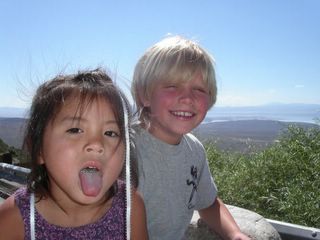
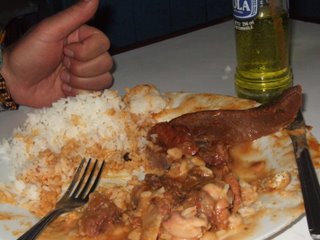
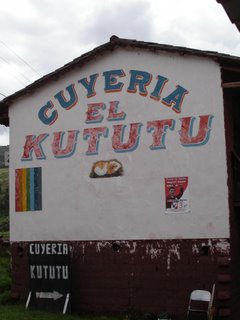
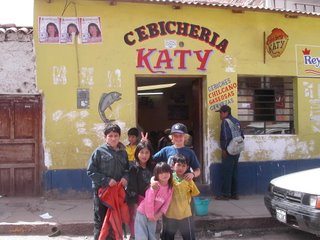
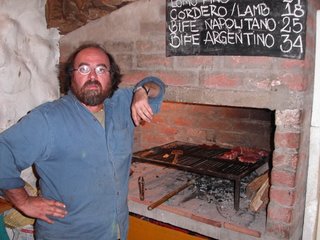
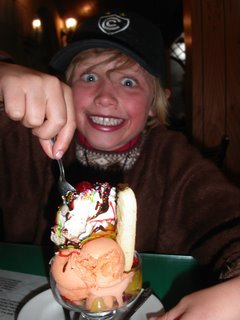
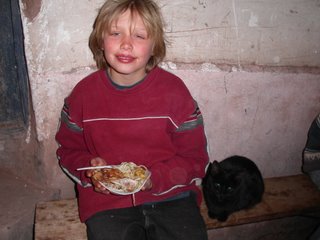
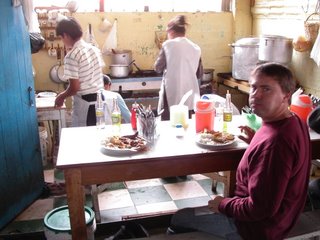
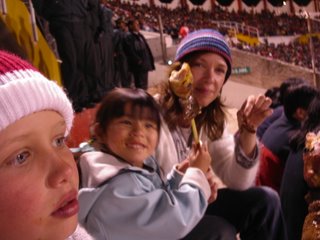
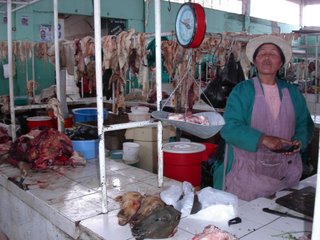
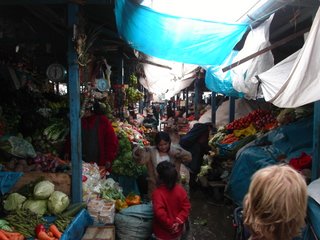
One of the great things about Cusco is the food. Not only is Peruvian food great in itself, but, if you think about it, it´s kind of great to go to a place where they have a type of food. When´s the last time you went out for American or Canadian? While there are, of course, different types of food, also of considerable interest to the tourist are the different types of places in which to enjoy said food. The first stop for many are the traditional Peruvian restaurants, generally on or near the Plaza de Armas, which serve set prices menus of a soup, a main course, and a drink or dessert for around $3-7. Also catering to tourists are the funkier, hip restaurants scattered around the historic center of the city. The food, décor, and ambience in these restaurants are on par with any I’ve found in San Diego or LA and the entrées generally run around $10. However, if you want real Peruvian food you need to go to where the locals eat and that means getting away from the tourist traps and finding some Picanterias, Cevicherias, Cuyerias, and Chicharronerias. You may also stumble across the occasional Pollo Broaster or Pizzaria, which can be quite good but, it seems to me that it kind of defeats the purpose of going to a foreign country if you are going to eat the same food you can get back home (one of the nicest things about Cusco is that there are NO U.S. fast food restaurants in Cusco). The locals’ restaurants are both considerably cheaper, with multi-course menus running from about $.60-$2, and generally much more interesting; local color is free and there’s often an interesting dynamic that develops when you’re the only Gringo in the place. Then, for the adventuresome eater, there are the food stalls on the street and in the local markets. Above, you can see a picture of Bart dining at a stall in the San Pedro market and in the first picture, my plate of beef tongue and beans. There was no restaurant open in the evenings within walking distance of our house so a couple of times the kids and I have enjoyed a greasy but tasty noodle, French fry, chicken combination from a local street vendor. For $.30-.$60 you get a filling meal and, for no extra charge, an audience of usually one or more dogs and an ubiquitous black cat who is often more intrusive than the canines, as you can see in the picture of Zak above. Unexpectedly, one of the best places I’ve found for local food is the local soccer stadium. Instead of munching on hot dogs and peanuts during the game, you can choose from a plate of noodles with a fried egg on top or some delicious anticuchus (grilled beef hearts) on a skewer with a potato, which you can see Maya enjoying in the picture above with her mother and brother.

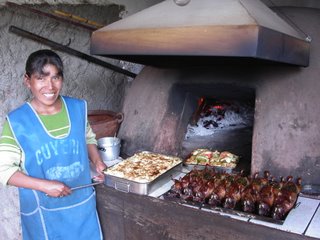
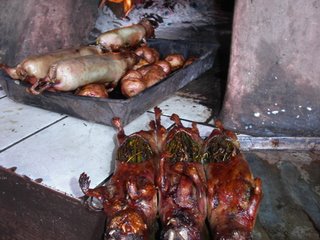
Then there´s the food itself. Of first interest to us furry mammal loving Norte Americanos is the Cuy or roasted guinea pig. I have to admit that I like them both as pets and meat although, even cooked, the skin can be a bit chewy and one has to put in a pretty workout with the incisors to get a decent amount of meet off of the little rodents. Alpaca is also very cute one the hoof, tasty on the plate, and surprisingly lean; look for the places that serve it in thin slices. Ceviche also originated in Peru. For the uninitiated, ceviche is raw fish marinated in limes and onions. It tastes as good as it sounds! Actually, the acids from the citrus essentially cook the fish leaving you with a cool, flavorful repast that accentuates the subtle flavors of the fish without that “fishy” smell so many people seem to dislike. Ceviche is generally served with sweet potatoes, roasted corn kernels, rice, and is accompanied by a soup made from the citrus/fish juices, muy rico (very good)! At the cevicheria you may also want to try a shot of the Leche de Tigre which supposedly gives a little boost to your virility, although I suspect that is more from the act of actually drinking the raw fish juice concoction than any inherent medicinal properties in the drink itself. In an earlier post I mentioned chicharrónes and hey, pig fried in pig fat and served with salt and corn has got to be good… and it is. Most chicharrón restaurants also serve caldo, a soup with a base of pork in a fermented broth. Fermentation certainly has it’s time and place – it’s downright indispensable to happy hour – and while that time might extend to the soup course, it requires a bit of an acquired taste to extend that place to the soup bowl. The corn served with chicharrónes is worthy of mention itself. The kernels are huge and sweet and light yellow. You can also find boiled ears for sale on the streets or in markets served with the local salty, white, soft cheese. Keep your eyes open for street vendors serving roasted corn kernels with salt (as well as Abas, a type of big legume); bonus if they’re still warm. They´re excellent with a glass of the local Cusquena lager (but then most things are)! Potatoes also originated in peru and, apparently, hundreds of varieties are available. Local food tends heavily toward the carbohydrates. For one thing, carbs are cheap and filling and also are apparently advantageous for metabolizing oxygen at high altitudes. However, a steady diet of such food isn’t too kind to the waistline; as is evident in every woman of childbearing age I saw. My local friends were incredulous that my wife Mary was on the positive side of 25, the mother of two children, and still looked great.

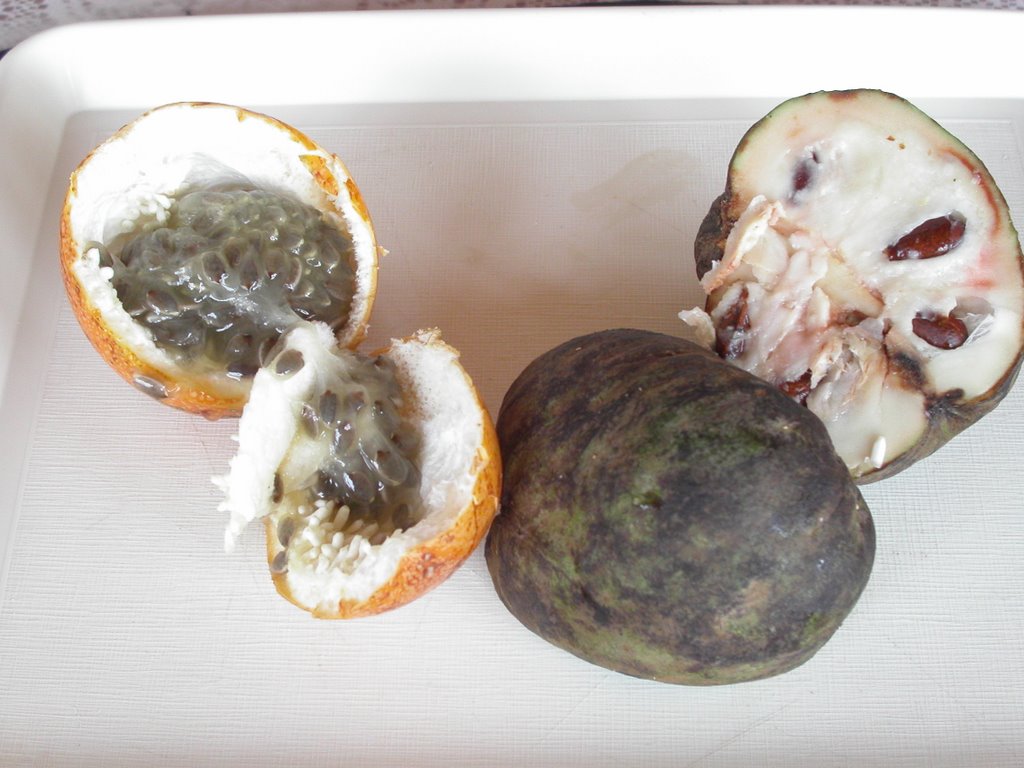
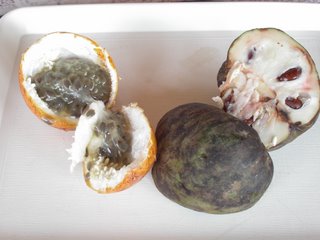
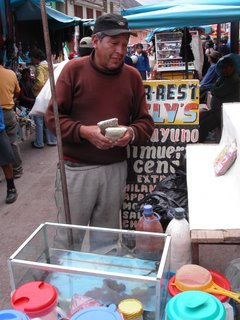
While we in North America have gotten used to having fresh bananas and oranges and apples at any time of the year, it never really crossed my mind before I left that I would have an entirely different crop of fruit to choose from down here in South America. In the picture above you can see two of my favorites. On the left is a Granadilla. Once one breaks through the crunchy shell, one is rewarded with a bunch of small seeds attached to each other by a king of sweet viscous material. When you slurp down a glob you get the interesting sensation of eating some that is sweet and smooth and crunchy all at the same time. This was also one of Zak´s favorites although, interesting, both his mother and grandparents couldn’t get past the texture which is not unlike the sensation of slurping down a big “loogie” albeit one that is quite tasty. On the right is a cherimoya. The flesh is sweet and fairly solid and surrounds big black seeds which you have to spit out as you eat. The final picture is of a food that even I didn’t try. Mary and I saw a tank of frogs at a local (non-tourist) market in Urubamba. I asked if they were for pets and the man replied that no, they were meant to be blended with some sugar and dark non-alcoholic beer and consumed. He assured me that they were of great benefit for the treatment of the common cold. This information was confirmed by my friend Jaime the taxi driver who went on to tell me about a variety of home remedies used in the campo by the campesinos who have neither access to nor money for the fancy medicines in a pharmacy. My theory is that any kid with a cold who is threatened with said remedy is sure to say he feels better right away, even if he really doesn’t.

Then there’s the drinks. Zak and I were quite fond of Inka Cola. I enjoy it’s light cream soda flavor but Mary Walsh almost ruined it for me completely when she noted that it tasted, to her, like liquid bubble gum. The name, Inka Cola is not without its own significance. To me, the two words represent the essence of both the ancient and the modern and the conjunction of these two words in the name of a popular soda is indicative of the struggle faced by this country as it tries to straddle the divide between these two realms. Many places will also serve chicha morada, a semi-sweet natural drink that apparently a healthier than sodas. At outdoor markets one can also find chicha quinoa, which is refreshing and contains negligible amounts of alcohol and, on the stronger side, there is chicha, the thick homemade corn beer which is served at room temperature. For the more traditional malted alcoholic beverage there is Cusquena, a local beer which comes in a lager and a dark, sweet malt. Interestingly, Cusquena is the largest manufacturing entity in town and is the only major economic enterprise other than tourism. The local strong alcohol drink is called a pisco sour which is evocative of a margarita. Like a margarita, which combines tequila and triple sec, pisco sours combine a harsh tasting pisco, which is actually a fortified wine, with a sweet, syrupy jarabe. The two are then blended with egg whites and little angostura bitters for a foamy delectable delight. A word of warning: as Bart and Susie and I discovered, much to our delight, one night after happy hour at the Cross Keys on the Plaza de Armas, it is very difficult to distinguish a strong pisco sour from a weak pisco sour. My theory is that traveling is also something done with the stomach so put down that hamburger and get out there!

Saturday, May 06, 2006

Santa Clara Convent


After three tries, I finally got the opportunity to attend Mass at the Church and Convent of Santa Clara. I´ve attended Mass at most of the large churches near the city center of Cusco and I´ve enjoyed the experience greatly, both for both the spiritual uplift and for the pomp and grandeur of the masses in these impressive houses of worship. While the Cathedral and La Compania, another large church built by the Jesuits, are certainly the most impressive churches in town, Santa Clara is probably the most interesting. First, the mass is only held at 7:00 a.m. which is explicitly not one of the times listed outside of the door, a technique used, I´m convinced, to deter tourists. My friend Mary Walsh, who is a lifelong Catholic whose mother should be a candidate for sainthood, was even told that tourists were not welcome and was turned away. Second, the church is a cloistered nunnery-the oldest in Peru-and the nuns sing from behind a heavy metal grate in the back of the church, seperate from both the worshippers and the Priests. Third, the congregation is primarily made up of indigenous people and older women. Neither group is known for its height and no one in the church even came up to my shoulders which made me slightly self-concscious as I stood near the front of the church. Fourth, I was standing near the front to better appreciate the primary focus of the interior decor, the thousands of mirrors that cover almost every part of the front and side altars. Not surprisingly, the early Spanish invaders had a hard time attracting Christian Converts and, as the natives were fascinated by mirrors, mirrors were installed throughout the interior of the church to attract congregants. Just another day off the beaten path.

Friday, May 05, 2006

Huatia Sunday


On Sunday, we went to the Ttito Villacorta’s for a special meal. Apparently, during the months of May, June, and July it is not uncommon on Sundays to build an outdoor rock oven called a Huatia in which potatoes and Okas (a type of sweet tuber) are roasted. As opposed to barbecues in the U.S., where typically only the men flex their primal instincts and cook over the open flame, everyone participated in the preparations; it was actually the 70 something grandmother (she of few teeth) who took primary responsibility for the fire. Once she got a decent one going with the scrap wood scattered about the yard, the tubers were put in the oven on top of the coals, a pickaxe is used to collapse the oven on top of the coals and potatoes and the whole thing is buried in dirt and allowed to cook for about 40 minutes. During that time we took turns drinking some chicha out of the one communal glass and, when a consensus was reached on cooking time (based on the relativity of our hunger and the probability of the potatoes being edible), the pickaxe was used to scrape away the dirt and a few of use got in and played ¨hot potato¨, pulling them out of the former oven with our bare hands and throwing them on a beautiful old manta (small blanket) that would have looked great on my wall but was reserved for use in the yard of the Ttito Villacortas. By this time, Bart was looking forward to the feast. He assumed someone would wash the potatoes and cover them with the cheese we had brought for the occasion. I’ve been around a little long and knew better. The potatoes were just carried over to where the chairs were sitting in a circle outside, we peeled off the dirty skins with our dirty hands, picked up hunks of the white cheese which soon turned brown from the same dirty fingers and dug in. Mama Villacorta brought out some green sauce which really tasted good on the potatoes. Maya pretty much hovered over the sauce scooping it over her potatoes and allowing the overflow to fall back into the bowl. The food was great but Zak was more interested playing with the cuys and some baby kitties but we all had fun. In addition to the cheese, we brought some sodas which are know here as gaseosas. I much prefer the local term as it better reflects both the effervescence in the bottle before consumptions and effervescence in the alimentary canal after. The sodas and cheese represented the largest capital outlay of the meal as potatoes are relatively cheap and plentiful. In addition, I brought some clothes our kids had outgrown. Mary brought them down to Peru with her and they were so appreciated, the kids started calling my Papa Noel (Santa Claus) as I pulled them out of the bag.

Thursday, May 04, 2006

Cusco Fun


The trip is winding down and while we are all looking forward to seeing friends and family back home, we also want to take advantage of our remaining time in Cusco and do all of the things we´ve been talking about doing while we are here. Bart and his new girlfriend Susie were here visiting (they are so in love it´s almost campy) and we all had a great time together. On the day before Susie left we went to the interestingly-named X-Zone which consists of a series of limestone outcroppings which have been riddled with a series of caves and tunnels over the centuries. The Incas apparently found the place interesting as well as there are a number of carvings and the remains of some Incan buildings as well as a couple of incredibly constructed retaining walls. We walked from there to the Inca caves of Salumpunko (note the passage to one carved in shape of a llama head) where we hired horses to take us the back way to Sacsaywaman. It was Zak’s first time on a horse and he loved it! He had a gentle white horse named Capa Blanca (Snowy Peak), mine was named Tornado, Bart had Pinto and Susie, as the most experienced rider, was given Viento (wind) who somewhat resembled a burro and, perhaps consequently, had something of an attitude problem. I decided his named stemmed not from his ability to run like the wind but to break like the wind, the comment did little to improve his humor. Approaching Sacsaywaman from this side, we were able to explore some Inca tunnels including one long one in which a young couple was sequestered inside the exit. Susie wanted to go to some interesting looking rounded white rock outcroppings nearby and shoot a couple photos for her sister who is a geologist and, much to our delight, we discovered some smooth grooves down the rocks which were perfect fit for our buttocks and allowed for a very fast slide down to the bottom. Slowing yourself down was an impossibility, all one could hope to do was to absorb the impact of the landing with your legs. The three guys had a ball trying out different slides Susie’s pleasure was limited to taking pictures of us zipping down the slides and out of control in more ways than one. I don’t think here amusement was any less than our own.
Wednesday, May 03, 2006

White Water Rafting


Zak didn´t have school on Monday because of a national holiday so, not wanting moss to grow under our feet, we invited his friend Camelo to join us for a day on the Villcaimamba river. The last picture shows us with our paddles over our heads shouting our boat´s team name, ¨the Diablos!¨ Please note Moms: we were able to charter a trip including boats, guides, safety equipment, safety kayaks, etc. The rapids we encountered were class II and III and were big enough to be fun but not dangerous. As an encore to his BVI exploits, Bart was the only one to fall out of the boat and we all had a great time.

So, who were these Incas anyway?


So, who were these Incas anyway? First, just to make things difficult, THEY weren’t really the Incas. The term Inca actually refers to the head honcho, the el jefe, THE Inca. The Spanish mistakenly applied the name to the entire group. Some scholars prefer to refer to the civilization in question as the Quechua as Quechua was the language spoken by the Incas and, interestingly, is still the common language of the locals in this area. But, even though referring to the civilization as the Incas is a bit of a misnomer, for the sake of simplicity, the mistake will be perpetuated in this blog, sort of like how those of us in the Americas refer to the indigenous people of the Western Hemisphere as Indians because some old dead White guy refused to stop and ask for directions and landed on the wrong continent.

Things really got rolling for the group that would become the Incas in the 1430s. Prior to that time they were a relatively small group who had lived a relative simple and peaceful in the Cusco Valley for two or three hundred years. However, on or around the early 1430s, their idyll was interrupted by the Chancas who, in rather poor taste, attacked the Cusqueños and, not only disrupted at least one entire afternoon’s diversions, but were in fact on the verge of defeating the Cusqueños. Things looked so dire, the leader of the Cusqueños actually fled town convinced that all was lost. His son, however, continued the fight and was able to get his people to rally so fiercely that, according to legend, even the stones fought on their side. As you can guess, the Chancas were defeated and the son took over the reigns of power adopting the title of Inca and the name Pachacutec, meaning “transformer of the earth.” He claimed to be divinely descended from the sun and his wife (who was also his sister) was the daughter of the moon. Therefore, much like the divine right of kings in Europe, as a direct descendent and local representative of God, to rebel against Pachacutec was to rebel against God himself. As a result of their experiences with the Chancas, the Incas, under Pachacutec, switched their foreign relation’s strategy and began a period of expansion and imperialism that was as ruthless as that of the Spanish at whose hands they would eventually be defeated (any parallels with current events can be drawn by yourself). Within Pachucatec’s lifetime, the Incan empire was extended from as far North as what is now Columbia and as far South as present-day Chile. Groups that resisted were summarily vanquished and the defeated people were often either slaughtered or relocated. Rather than face this fate, other groups who joined the Kingdom willingly, “the Incas may now be in charge but at least they brought in sewer and water,” maintained a large degree of regional autonomy as long as they worshipped Inti, the sun, as their supreme God (after all, it seemed to be working well for the Incas) and paid levies, often in the form of labor for the massive building projects that were being undertaken by the Incas. The Incas, for their part, often integrated some of the newly annexed culture’s religious themes into their own. They also studied the new culture’s agricultural, architectural, metallurgical, medicinal, textile and pottery techniques and were thus able to integrate an extensive body of knowledge into their own in a relatively small period of time. As a result, they were able to develop intensive agricultural practices, developing new strains of crops in places like Maray that could grow in the high elevations of the Andes and, in order to maximize the amount of arable land in this mountainous region, they built extensive terracing systems, some of which are still in use today. The Incas didn’t have much for domestic livestock beyond llamas and alpacas before the Spanish arrived but they were consummate farmers. Consequently food was produced at a level surpassing current production allowing the empire to support a larger population than that of today while storing enough food to feed the population during bad years and eliminating hunger throughout the empire. The leaders of these captured peoples were brought to Cusco as Vassals were they lived in relatively comfort and opulence as long as their subjects bacsk home continued to cooperate. By this time, Cusco, known to the Incas as the “navel of the world,” was a fairly cosmopolitan city of about 100,000 homes in which scores of languages were spoke although Quechua was used universally. By the time the Spanish arrived in Cusco, they found a city that, according to one of Pizarro’s men, “is so beautiful and has such fine buildings that it would be remarkable even in Spain.” The religious center of Cusco, the Qoricancha, consisted of a number of temples – to the sun, the moon, to rainbows, thunder and lightning, and the stars – some of which had walls that were completely covered in gold or silver. A large golden sun disc reflected the sun’s rays into the gold-lined temple of the sun, filling the entire temple with the golden radiance of the sun. There were ritual treasures representing objects of import to the lives of the Incas: a field of corn with stems and leaves made from silver and ears made from gold as well as llamas, butterflies, birds, plants and trees all made of pure gold.

Alongside the ongoing imperial expansion, under Pachucatec the Incas began massive building projects like Pisac, Ollantaytambo, Machu Picchu, Sacsaywaman as well as hundreds of other less well known constructions including wacas (shrines) and tambos (post-houses for royal messengers who ran throughout the empire delivering messages coded on knotted ropes). The sites were located on a system or radiating lines or ceques from the center of Cusco and were maintained by regional clans or kinship groups known as ayllus. The construction techniques utilized by the Incas continue to amaze and impress laymen and experts alike. All of these sites were connected by over 40,000 km of paved roads over rugged mountainous terrain utilizing bridges, tunnels, drainage ditches, etc. in the process. These sites were built to last and many remain virtually unchanged, a testament to the building techniques of the Incas.

Food and other resources were shared by al throughout the Incan empire but this was no hippie commune giving lip-service to equality, rather the Incan society was strictly and hierarchically organized with the head Inca at the top followed by lesser nobility and others on down the line each responsible for progressively smaller and smaller groups of people. Inca rulers and other nobility were often mummified after death and continued to be consulted on important matters although the conversations must have been somewhat one-sided. They were given daily offerings of food and drink and taken out and paraded around town on special occasions (perhaps not unlike our Señor de los Tremblores?).

The Inca civilization was one of the largest and most successful pre-modern civilizations. In terms of size and effective governance, the Incas were on par with the Roman Empire. Their dominance in South American seemed assured until a group of bearded strangers appeared on the scene.

Play Which of These is not Like the Other!


If you can tell the difference between the locals and the gringos in the first two pictures, you also begin to understand the difference in social situation of these two groups. The third picture is of the Last Supper painted by a Cusco artist not long after the Conquest. He added a few points of subterfuge. Note the cuy served as the main course as well as the Andean cheese and vegetables. You might also not that Judas, seated in the front right holding his ill-gotten gains, is of much darker skin than the others. Apparently the artist used the face of Francisco Pizzaro as the model for Judas´face. The final picture shows a fresco from a church in Pisac in which Andean themes are included by the church to attract converts. Note the woman and boy in native dress and that the boys holds a baby llama instead of a baby sheep.